There isn’t really a better project to talk about cladding and façades than the Ronald O. Perelman Performing Arts Center shown below.


This Façade in particular makes use of a ‘single skin’, which is made up of Estremoz Marble quarried from Portugal, refined through various stages to produce an insulated and structurally sound tile, attached to a bespoke metal frame and affixed to the 4 sides of the building. This façade was complete in October 2021.
What is a Façade?
A facade is the exterior face of a building. From a design standpoint it is one of the most important aspects of the building, since it carries the architect’s aesthetic intent while forming part of the barrier that protects the interior from the elements. The facade has to ensure energy efficiency as it is part of that barrier – while, in the case of the ‘single skin’ example above – the facade was the energy efficient layer as well as the aesthetic.
For high-rise buildings, the facade is normally suspended from floor slabs made of concrete or the core structure of the building, by use of an aluminium or stainless steel frames as generally this frame is visible but it depends on the design. A vast amount of engineering know-how goes into the design of the frame as it is subject to natural elements such as the wind and rain. It is therefore important that safety is taken into consideration as part of the engineering process, where you will observe specially calculated loads and fixing hardware with a high wind-load rating.
What is a Dimension Stone Façade?
A dimension stone facade is an exterior wall clad in natural stone that has been cut and finished to precise sizes and shapes to suit the architect’s design. The stone is chosen for its ability to be joined together to create a seamless pattern or design, or to be manipulated with degree by degree accuracy, as in the case of the Performing Arts Center in New York City seen below.

Dimension stone is clearly showing what can be produced from a natural material, whether it is trimmed, cut, drilled, ground or something else, such as again the project example above, the marble was turned into a single skin glazing unit for the entire facade, carefully positioned using the natural pattern and tones.
Sustainability of Stone Facades
Using dimension stone as a facade is extremely sustainable, it is in fact one of the most sustainable building materials on the planet, since it is created by separating blocks from the natural bedrock which underlies all naturally occurring land on every continent. The process itself does not emit any direct greenhouse gas emissions, dust is controlled and the water used for cutting/drilling etc is almost always recycled.
It is said that humans as a species could never use up all of the stone under the land we live on, which is reinforced by strict rules set by the rating system LEED (Leadership in Energy and Environmental Design).
Facades in Architecture
As we have touched on above, facades and cladding from an architect’s point of view are extremely important to the overall aesthetic of the building, and this is true of both internal and external walls.
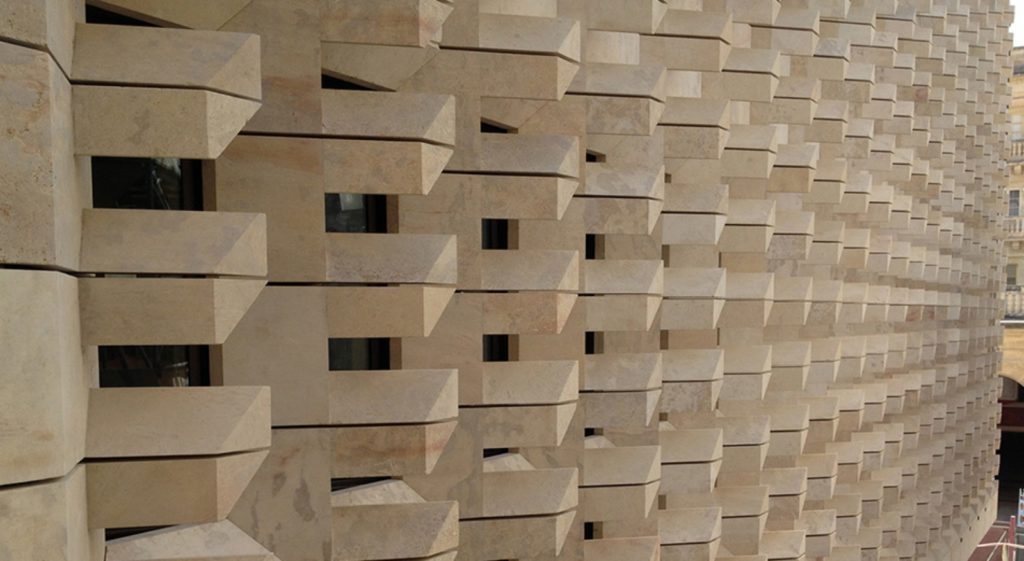
Another great example of using dimension stone to really add a spectacular dimension to a design is the Valletta City Gate in Malta, designed by Architects Renzo Piano Building Workshop.

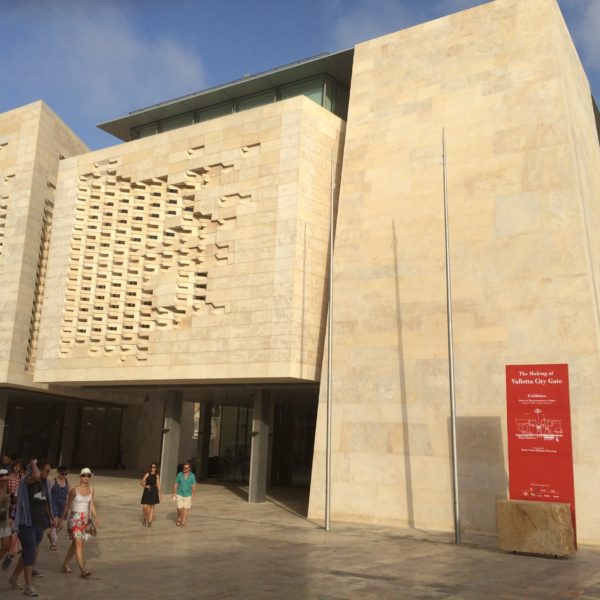

This new series of buildings replaced the 4th city gate to become the 5th city gate, it is a redesign of the city entrance which has happened 4 times before, but this time the project included returning the ruins of the Royal Opera House into an open-air theatre known as Pjazza Teatru Rjal, as well as a new parliament house.
The dimension stone used throughout the entire project is Maltese Hardstone Limestone which was quarried from a location not far from the city gate on the island itself. More than 12,000 cubic metres of the stone was used in the production of the exterior and interior facades, cladding and flooring.
There is a steel frame structure which is load-bearing and this supports the Maltese Limestone which is hung from the steel as both cladding and interior lining.
The way the stone has been carved is to replicate natural erosion and solar shading, so there are angular louvers, to create a ‘dynamic play of reflection and shadow’, this recalls the Baroque richness of local churches and palaces.
What Material Categories are Suitable?
There are many varieties of natural dimension stone that make for excellent cladding materials, these include stone from the three geological groups: Sedimentary Rocks such as Limestone and Sandstone, Metamorphic Rocks such as Slate and Marble and Igneous rocks such as Granite.
- Basalt. Basalt is suitable for both interior and exterior wall natural stone cladding and facade applications. One of its features is a high insulation capability
- Bluestone. Bluestone is a name given to many stone materials with a blue tint, there are approximately twenty of these. It includes Basalt, above and limestone
- Granite. Granite is easily one of the most common materials for both interior and exterior cladding applications and it occurs widely all over the world. It has very high durability and permanence of both its colour and texture.
- Jerusalem Stone. This is one of the oldest stones used in building construction and as an exterior cladding material. Jerusalem Stone is extremely dense and more resistant to weathering than other limestones.
- Limestone. A highly diverse and colour flexible material, Limestone ranges from pure whites, to subtle browns with hints of blue. It can be carved and shaped relatively easily, making a great option for facades.
- Marble. Marble has a diverse array of colours and textures but has seen a decline in use due to its more difficult handling and processing, making cheaper alternatives more favourable to large projects. Use of modern engineering techniques can massively improve the resilience and core structure, such as lamination and glazing.
- Slate. Slate is a fine-grained metamorphic stone that is optimal for both interior and exterior cladding. It is excellent for water resistance and is low-maintenance, it also has a sophisticated appearance.
Further Reading…
Read about Ventilated Stone Facades, their benefits and how they work.
Read our article on What is Dimension Stone?